
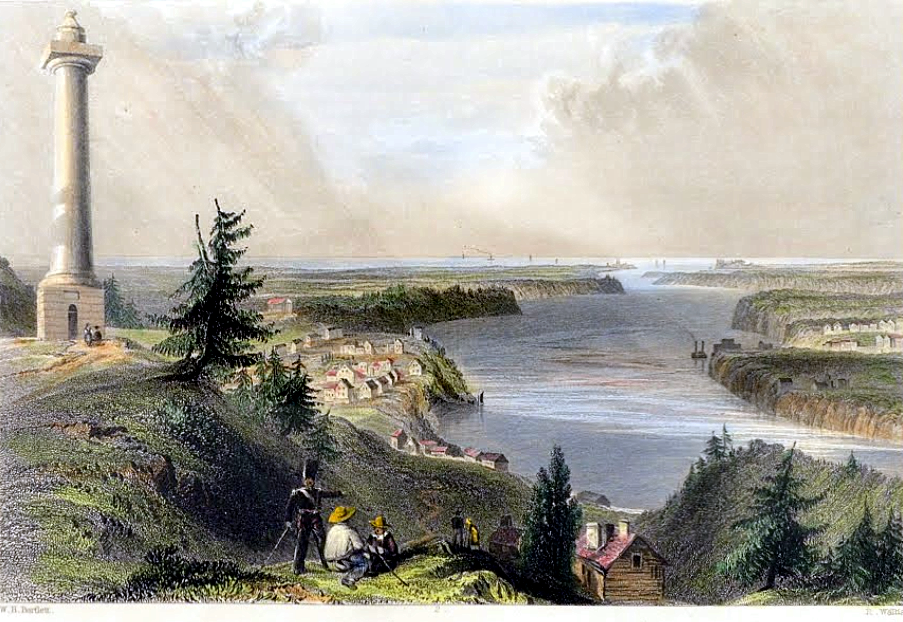
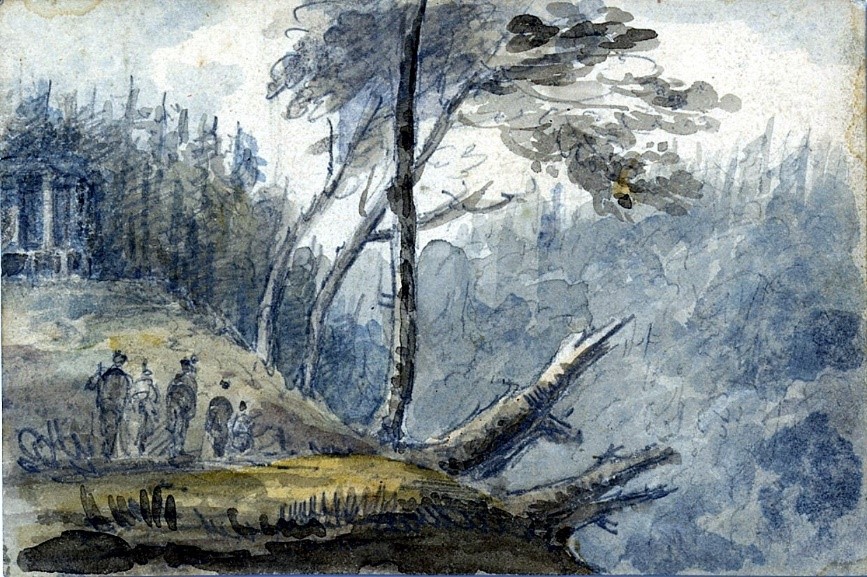
Elizabeth Postuma Gwillim Simcoe was the wife of John Graves Simcoe, the first Lieutenant Governor of Upper Canada. She was an accomplished artist and between 1791 and 1796, as she travelled throughout Upper and Lower Canada, produced a large number of sketches and watercolours depicting Canadian scenes. She was also an avid diarist and wrote about many of her experiences.
These diaries and paintings combine to create a vivid portrait of both the raw beauty of the untamed landscape and the day-to-day life of a gentlewoman in pioneer times.
Baptized on September 22, 1762 in Aldwincle, Northamptonshire, England, she knew neither of her parents. Her father, Lieutenant-Colonel Thomas Gwillim, died prior to her birth (hence, her middle name “Posthuma”) and her mother died in childbirth.
The orphaned child was raised by her mother’s younger sister, Margaret, who married Admiral Samuel Graves on June 14, 1769. In the spring of 1782 while living at the Graves’ Devon home, Elizabeth met the admiral’s godson, John Graves Simcoe. They were married later that year. Elizabeth was 16 and John was 29.
Following their marriage, the Simcoes moved to Exeter, where their first three children were born. Then, with the substantial inheritance she had received from her parents, they purchased an estate at Wolford near Honiton, in Devon. Living a “secluded” life at Wolford, Elizabeth and John set about improving the property. She also gave birth to five more children.
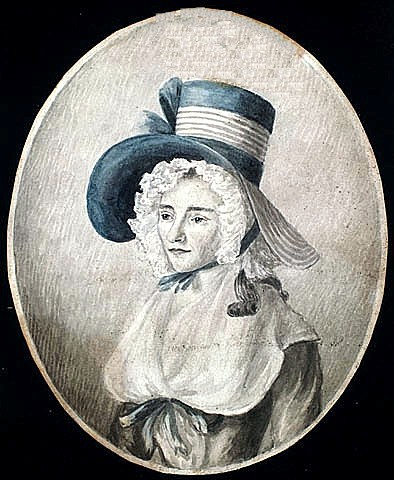
In 1791 John was appointed Lieutenant Governor of Upper Canada and accompanied by their two youngest children, they set sail for the colonies.
September 26th, 1791
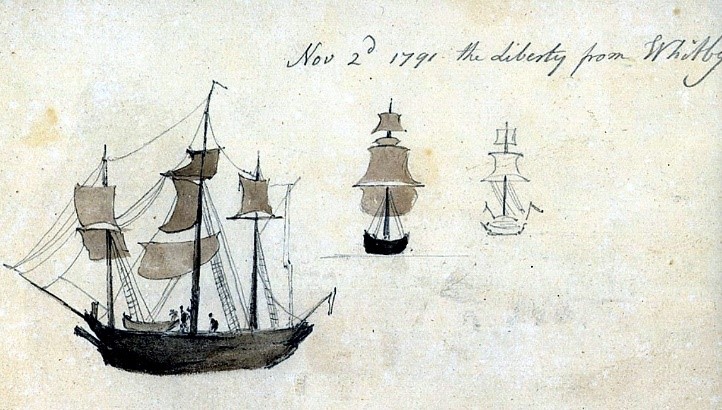
“Wind east, blowing fresh, fine and clear. It became calm this morning, and at one o’clock p.m. we embarked on board His Majesty’s frigate “Triton” 28 guns…I became giddy (seasick) as soon as I entered the ship and went to my cabin, an apartment just large enough to swing a cot, which I immediately got into. On leaving Weymouth …one of the port hole windows was stove in and the gentlemen at dinner were quite wet.”
October 15th, 1791
“Wind NW, cold, hard gale. This hard gale did not cool the cabins, which had been so extremely heated. I was, therefore, glad to be on deck to get rid of my headache, notwithstanding the weather was so rough that I was obliged to hold fast by a cannon. The waves, rising like mountains, have the grandest and most terrific appearance, and when the ship dashes with violence into the sea, much as a chaise in the act of overturning, it is surprising she rights again. I viewed this tempestuous scene with much astonishment.”
October 29th, 1791
“…we saw the Gut of Canso at a distance. At four we saw at the south end of Cape Breton, Richmond Island, so called in some charts, in others Isle Madame…it is a bold and perpendicular, dark red rock. Shaded almost to black and covered with pine”

The Simcoes reached Quebec City on November 11th, 1791
The couple was wined and dined and soon became fixtures of local society. The Simcoes were to winter at Quebec before beginning their long trip into the interior and the town. Colonel Simcoe’s duties were in Upper Canada and with the arrival of better weather the family prepared to leave Quebec.
“I dined at Coll. Caldwell’s and soon after I returned home. Coll. Simcoe arrived from Montreal which place he left yesterday & brought with him Mr. Talbot of the 24th Regiment, a relation of Lady Buckingham, who was Aide-de-Camp to the Marquis while he was Ld. Lieutenant of Ireland and at whose request Col Simcoe takes Mr. Talbot into his family.”
The officers put on plays but Colonel Simcoe refused to attend, thinking the activity beneath their dignity. Indeed, he complained that there were “few men of learning or information” in Quebec. But his aide, Thomas Talbot, arranged Mrs. Simcoe’s dinners and dances, and out of her intensive social round she wrote happily that she found Quebec a delightful place. “Everybody I see assiduous to please me”.
“Indeed, I think there are more amusements and gaiety here than a winter at Bath affords and that you would not expect in so remote a Country. The Prince’s Band cost him near five hundred a year being a selection of fine performers so you may suppose the Concerts are not to be despised.”
“I gave a dance to forty people. The prince was present. We have left the house. By removing a wooden partition up stairs, we have made a room 45 feet long with a tea Room and Card Room adjoining, which makes a good apartment for a dance, with a supper Room below.”
“The fusiliers are the best dancers, well dressed and the best-looking figures in a Ball Room I ever saw. They are all musical and like dancing and bestow as much money, as other Regiments usually spend in wine, in giving Balls and Concerts which makes them very popular in this place where dancing is so favourite an amusement, that no age seems to exclude people from partaking of it and indeed I find giving Dances much the easiest mode of entertaining company, as well as the most pleasant to them. Mr. Talbot manages all the etiquette of our House, is au fait in all those points which gave weight to matters of no moment”
TO UPPER CANADA
early on the morning of June 8th, 1792, the Simcoes, with servants and children in tow and accompanied by Aides-de-Camp Lieutenants Grey and Thomas Talbot, passed through St. Louis Gate at Quebec City, walked to the river and embarked for Upper Canada in batteau and canoe.
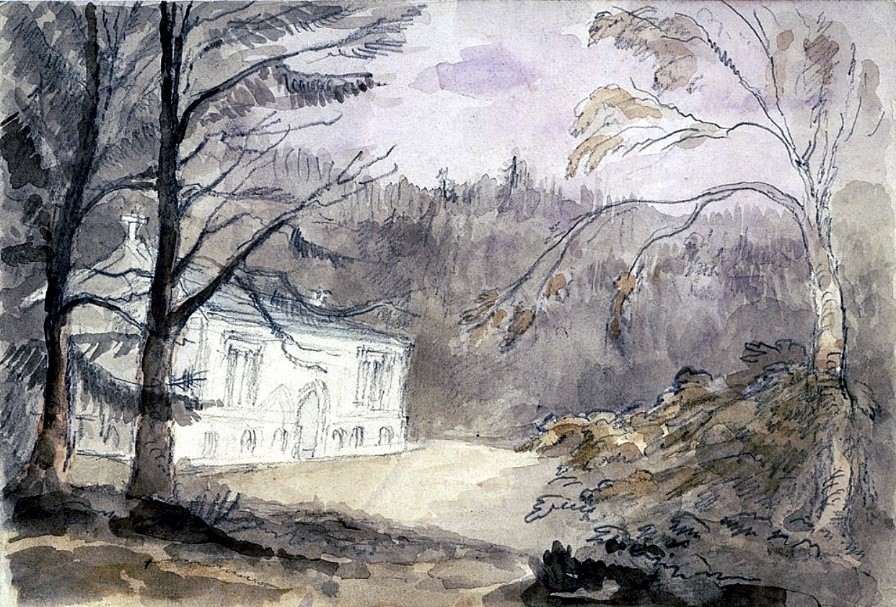
The Simcoes arrived in Kingston on July 31st, 1792.
Upon arriving in Kingston, Simcoe began to make preparations to leave for Newark [now Niagara-on-the-Lake] which had been designated the provisional seat of the new colonial government.
“I walked this evening in a wood lately set on fire by some unextinguished fires being left by some persons who had encamped there, which in dry weather often communicates to the trees. Perhaps you have no idea of the pleasure of walking in a burning wood, but I found it so great that I think I shall have some woods set on fire for my evening walks. The smoke arising from it keeps the mosquitoes at a distance, and when the fire has caught the hollow trunk of a lofty tree, the flame issuing from the top has a fine effect. In some trees where but a small flame appears it looks like stars as the evening grows dark, and the flare and smoke, interspread in different masses of dark woods, has a very picturesque appearance.”
Simcoe was sworn in as Lieutenant-Governor at Kingston on July 8th, 1792 and two weeks later, in spite of the efforts of local residents to dissuade the Governor from going to Niagara, representing the want of provisions, houses, etc. at that place, as well as the “certainty of having the ague”, the vice-regal party departed.
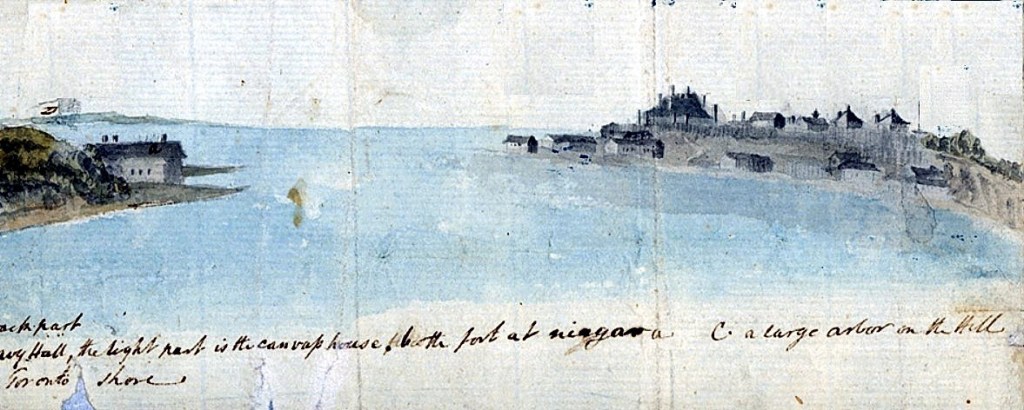
Niagara July 25th, 1792
“A clear cold day, made little way, a head wind. I saw the spray of the Falls of Niagara rising like a cloud. It is 40 miles distant.”
Navy Hall July 26th, 1792
The Simcoes docked at Navy Hall in Newark, Upper Canada. Navy Hall, part of a group of buildings which stood on the edge of the Niagara River, was used by British commanders who travelled to Lake Ontario. It served to supply military vessels which cruised to the western part of the lake. The first legislature was held there on September 17, 1792.
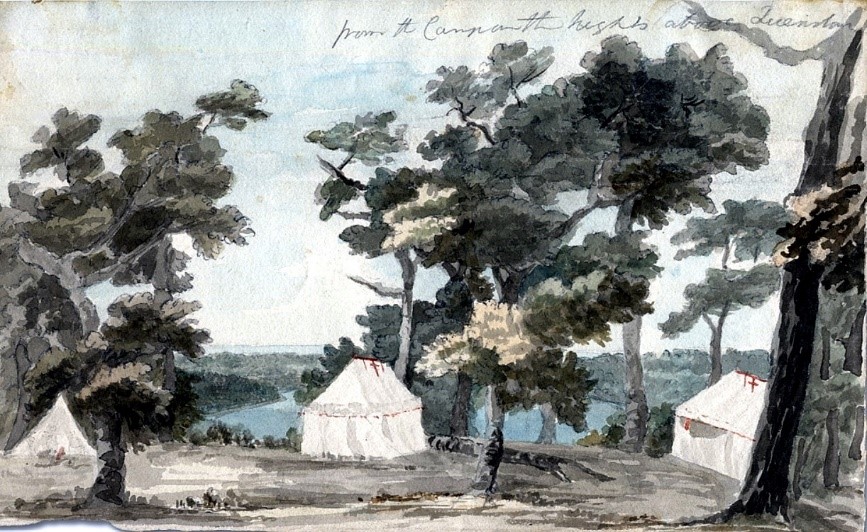
“Navy Hall is a house built by the Navel Commanders on this lake for their reception when here – it is now undergoing a thorough repair for our occupation but is still too unfinished that the Governor has ordered 3 marquees to be pitched for us on the hill above the house which is very dry ground and rises beautifully, in parts covered with oak bushes…”
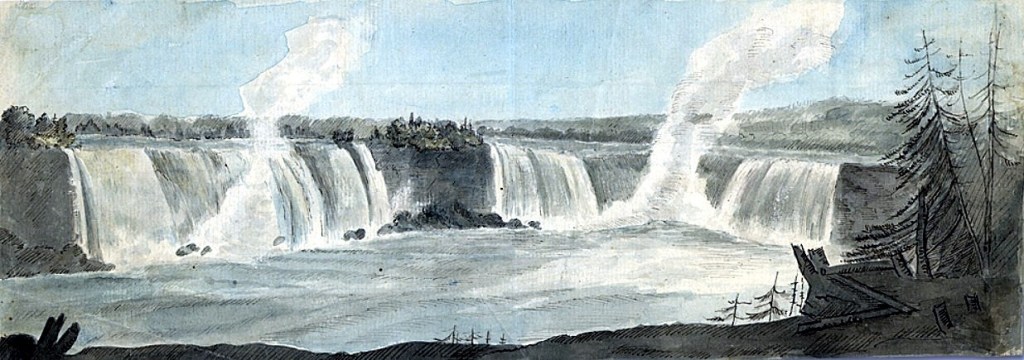
“…the fall is said to be but 170 feet in height, the river previously rushes in the most rapid manner on a declivity for 3 miles and those rapids are a very fine sight – the fall itself is the grandest sight imaginable from the immense width of waters and the circular form of the grand fall…the whole centre of the fall…is frequently seen a Rainbow.”
“I descended an exceedingly steep hill to get to the Table Rock, from whence the view of the falls is tremendously fine. Men sometimes descend the rocks below this projecting point, but it is attended with great difficulty and perhaps little picturesque advantage.”
“The prodigious spray which arises from the foam at the bottom of the falls adds grandeur to the scene, which is wonderfully fine, and after the eye becomes more familiar with the objects, I think the pleasure will be greater in dwelling on them.”
August 3, 1792
“…the Governor set out this Evening to sleep at the landing intending to go tomorrow to Fort Erie 30 miles – Mr. Talbot drove me and we returned to Supper at Navy Hall, we saw a fine Bald Eagle on the wing.”
August 17th, 1792
“I desired to drive out last evening, though everybody foretold an approaching thunderstorm, which indeed came on with great violence…I feared that the lightning would make the horse run away, but he only started at every flash. The recollection that it was my own determination [which] brought me into danger was very unpleasant. However, we got back safe and in time to save the marquees from being blown over. The Governor preserved ours by having the cords held until the violence of the storm was over. The tents were so near the river that were afraid they would be blown into it.”
“We were so cold and wet we were glad to drink tea. It was quite dark and too windy to allow of our burning candles…I wrapped myself up in two or three greatcoats and intended, if the tent was blown down, to take shelter under the great dinner table. The rain and wind did not cease for two hours, and we had no means of drying our clothes and were obliged to sleep in a wet tent. However, we have not caught cold.”
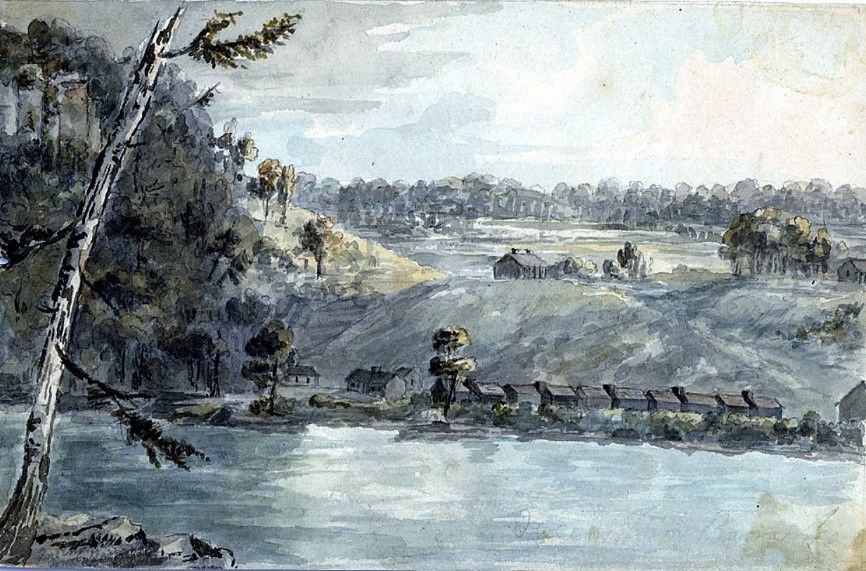
The Simcoes wintered over in Newark where Elizabeth gave birth to a daughter, Katherine, in mid January 1793.
February 1793
“The whole winter has been like an exceedingly fine, dry autumn in England; the climate is delightful and the country plentiful and a pleasant society within a certain circle; in short, we have nothing to complain of but not seeing the children and the absence of some friends.”
April 24, 1793 Newark
“I rode to the Whirlpool with Mr. Pilkington. As we came back it was almost dark and the fires the Indians had made by the water side for the purpose of spearing fish had a picturesque appearance among the rocks. The light attracts the fish and the Indians are very expert in spearing them.”
In early May 1793, Colonel Simcoe set off for his first brief visit to Toronto, travelling around the head of the lake by boat. He returned a fortnight later.
July 2nd 1793
“We have 30 large May Duke Cherry trees behind the House and 3 standard Peach trees which supplied us last autumn for tarts & Deserts during 6 weeks besides the numbers the young men ate. My share was trifling compared to theirs & I eat 30 in a day. They were very small but highly flavoured. When tired of eating them raw Mr. Talbot roasted them and they were very good.”
“12th Mr. Grey has just received orders to join Sir C. Grey in the West Indies. He is to go by way of New York. The Gov & Mrs. Talbot set out with him this morning to accompany him as far as Niagara.”
“Col. Simcoe returned from Toronto and speaks in praise of the harbour, and fine spot near it covered with large Oak which he intends to fix upon as a site for a Town.”
Then in early August, Simcoe returned to Toronto accompanied by Elizabeth and the children.
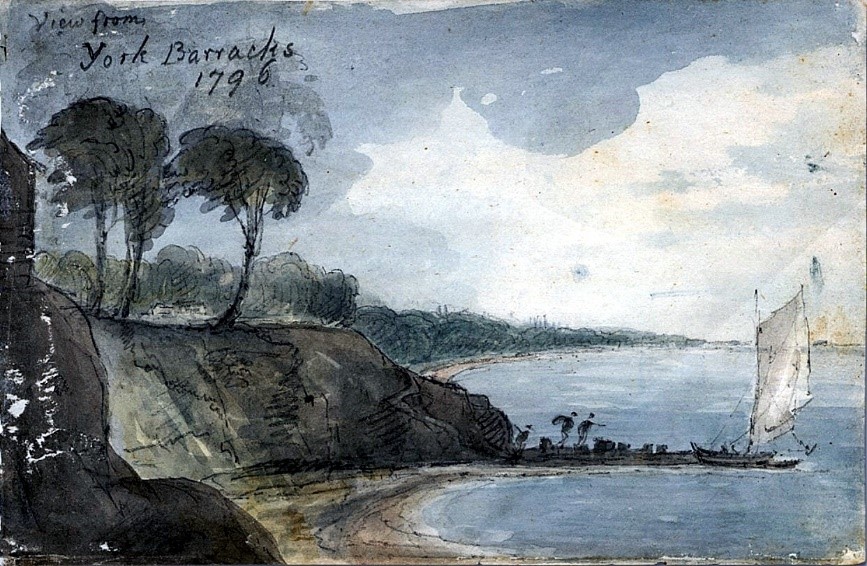
York August 4th, 1793
“We rode on the peninsula opposite Toronto, so I called it the spit of land, for it is united to the mainland by a very narrow neck of ground. We crossed the bay opposite the camp and rode by the lake side to the end of the peninsula. We met with some good natural meadows and several ponds. The trees are mostly of the poplar kind, covered with wild vines and there are some fir. On the ground were everlasting peas creeping in abundance, of a purple colour. I am told they are good to eat when boiled, and some pretty, white flowers like lilies of the valley. We continued our ride beyond the peninsula on the sands of the north shore of Lake Ontario till we were impeded by large trees on the beach…”
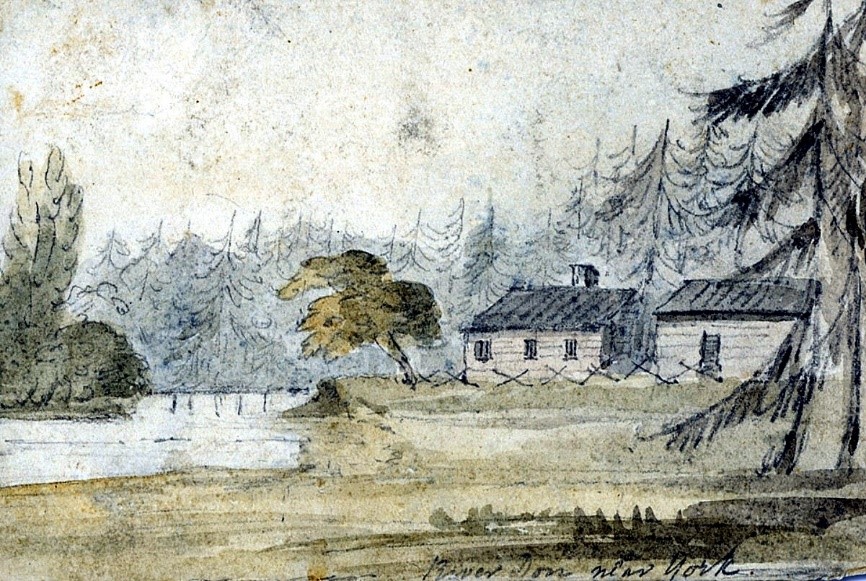
“…We then walked some distance’ till we met with Mr. Grant’s [Lewis Grant, the surveyor’s] boat. It was not much larger than a canoe, but we ventured into it, and after rowing a mile we came within site of, what is named on a government map, the highlands of Toronto. The shore is extremely bold and have the appearance of chalk cliffs, but I believe they are only white sand. They appeared so well that we talked of building a summer residence there and calling it Scarborough.”
On the 23rd of August, a proclamation was published officially renaming the town “York” in honour of the Duke of York who had recently saved Holland from invasion by the French. The name Toronto would be restored in 1834.
In York, Thomas Talbot, who was later to found the Talbot settlement, acted as Governor Simcoe’s aide and often walked or rode with Mrs. Simcoe when he was not travelling with the Governor. At York he was particularly useful; he and Mrs. Simcoe raced on horseback on the peninsula and she watched him skate on the frozen bay which the Shaw children ran about and set fire to the long grass.
September 13th
“Mr. Pilkington coasted the Lake and arrived here in two days about 100 miles”.
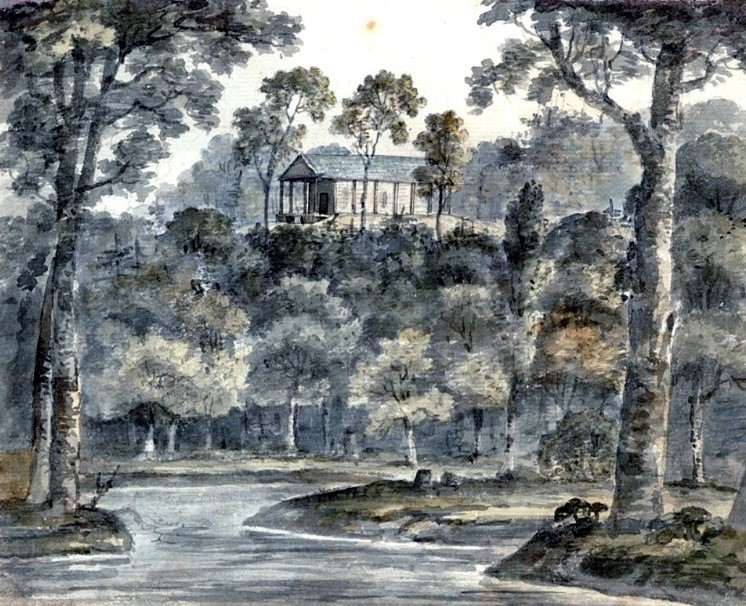
At first, the family slept in a “canvas house” – one of three or four large tents that Simcoe had bought in London at the sale of the effects of Captain cook, the explorer. Eventually, the Simcoes would build, not at the Scarborough Heights, but a couple of miles up the Don River.
“The Governor having determined to take a lot of 200 acres upon the River Don for Francis, and the law obliges persons having lots of land to build a house upon them within the year we went today to fix upon the spot for building his House.”
January 26,1794
“We went to the Donn to see Mr. Talbot skate. Capt. Shaw’s children set the marshy ground below the bay on fire the long grass on it burns with great rapidity this dry weather. It was a fine sight & a study for flame & smoke from our house. At night the flames diminished and appeared like lamps in a dark night in the Crescent at Bath.”
“Feb 14th, I dreamt some time since that the Gov., Mr. Talbot and I were passing a wood, possessed by an enemy who fired ball at us as fast as possible. I was so frightened, that I have never since liked to hear a musket fired and I am quite nervous when I hear of the probability of this country being attacked.”
In the spring of 1794, construction began on Castle Frank, the Simcoe summer residence. It stood on a steep hill overlooking the Don Valley and was named after the Simcoes’ then five-year-old son Francis who was to inherit the residence. The house was still under construction when they returned to England in 1796. Castle Frank would burn down in 1829.
While Simcoe was engaged directing the laying out of the town plot of York, Elizabeth busied herself by exploring the area and visiting neighbours such as John Scadding, the former manager of the Wolford Estate, who had emigrated to Canada in 1792.
February 9th 1794
“The weather damp, mild and dirty. When will the end of March arrive? I am quite impatient to set out for Detroit.”
In the end, Simcoe would travel to Detroit without Elizabeth. She remained in York where, in mid-April, with both Simcoe and the family doctor absent in the west, Katherine, her youngest daughter died.
Fri May 9th
“At 7 this morning we set off in a boat with the children and Mr. Talbot intending to reach the head of the lake tonight, but a very stiff breeze rising ahead about 4 o’clock we put on shore 12 miles short of it. The Tents were pitched and fires made. The Gov and I walked some distance on the beach and Mr. Talbot amused himself in barking elm trees as the Indians do and covering his tent with it, for it proved a very wet night we supped under umbrellas. The children & Junk [a nurse] slept on the office boxes in the tent.”
Return to Newark May 14, 1794
“Mr. Pilkington goes tomorrow to see & give orders for fortifying the new post at the Miami. He gave me some sketches taken on Lake Erie.”
June 4, 1794
“The ball was held in the council Chamber. The Gov & I & Mr. Talbot went in to the room after all the company were assembled. There were 22 couple. I did not dance. The ladies were well dressed. We supped at 12 in a room as large as the ballroom and we came away at 2 o’clock. The whole was extremely well managed as Mr. Talbot ordered it himself.”
“5th I was tired by setting up late & went to take an early dinner at the fort with Mrs. Smith. The Gov. had a large party of gentlemen to dinner. Mr. Talbot came for me in the evening and it was so cold we were obliged to wrap ourselves up in Great Coats and Tippits.”
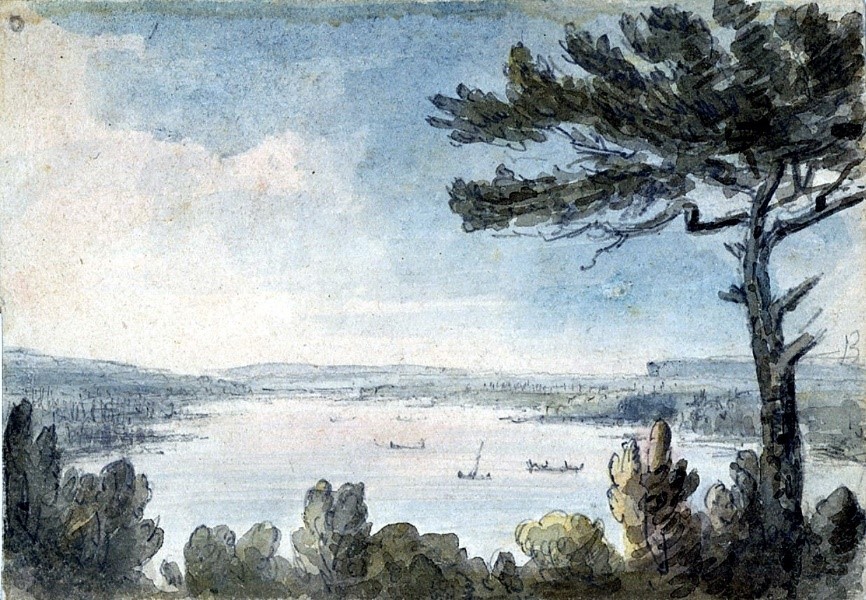
Friday Apr 14th, 1795
“The Governor has been so ill since the 21st of March that I have not left his room since that day. He has had such a cough that some nights he could not lie down, but sat in a chair, total loss of appetite and such headaches that he could not bear any person but me to walk across the room or speak out loud. There was no medical advice but that of a horse doctor who pretended to be an apothecary. The Governor, out of consideration for the convenience of the staff-surgeon, had allowed him to remain at Niagara and his not being made to attend his duty has caused me a great deal of anxiety to see the Governor so ill without having proper attendance. Capt. Brant’s sister prescribed a root – it is, I believe, calamus, a genus of palm, one species of which yields a resin called dragon’s blood, the root of which really relieved his cough in a very short time.”
Sept 20, 1795
“A wet morning. The Gov. went to Navy Hall. A cold Evening. Mr. Pilkington called.”
Sept 24, 1795
“Mr. Pilkington having been desired to put one or two short ladders to make the descent easy from rock to rock by the side of the Indian ladder (which is a notched tree). We set out today determined to make our way to the bottom of the Rocks below the Falls.”
The final year
The Simcoes would spend another year in Upper Canada, during which time Elizabeth painted and wrote in her diaries extensively.
In November 1795 the family sailed to York on board the schooner “Governor Simcoe” for a prolonged visit. They would winter there, returning to Niagara in April to open the legislature. However, it was to be a short visit. The Assembly was prorogued on the 3rd of June and 4 days later, the Simcoe family left Niagara again, to take a leisurely trip back to York.
Feb 13, 1796 York
“Mr. Pilkington arrived from Niagara. The sudden thaw obliged him to wade across the inlet at the head of the Lake.”
“14th Snow and frost, a dance tonight.”
“18th We walked to the Town and from thence drove on the ice to dine at C. Frank, the ice was good. Mr. Pilkington sketched the house. The Winter Express arrived from Quebec.”
February 19, 1796
“Mr. Pilkington went in a boat to the head of the Lake. We dined in the woods on Major Shanks’ farm lot where an arbour of Hemlock Pine was prepared, a band of music stationed near. We dined on large Perch & Venison. Jacob the Mohawk was there. He danced Scotch Reels with more ease & grace than any person I ever saw, and had the air of a Prince. The picturesque way in which he wore and held a black blanket, gave it the air of a Spanish Cloak, his leggings were scarlet, on his head and arms silver bands. I never saw so handsome a figure”.
June 4th Newark
“Mr. Pilkington has erected a temporary room adjoining our house for the Ball room tonight. It is 60 feet long and the end ornamented by colours. We danced 18 couple and sat down to supper 76.”
6th June
“Francis 5 years old today. Mr. Pilkington drew his picture. The Governor drove me to the Landing to take leave of Mrs. Hamilton. It was very cold returning. I drank tea at Mrs. Smith’s and met Mrs. Montigny and Miss Hay from Detroit.”
June 12th 1796
“This part of the mountain is said to abound with rattlesnakes and why I did not meet them in these unfrequented places I do not know. I gathered a great many plants. Green gave them all names and I stopped at his house to write them down. Ginseng, a root highly valued as a tonic, which the merchants tell me they send to England and in some years has sold at a guinea a pound; sarsaparilla; consumption vine, a pretty creeper. Green’s daughter was cured of consumption by drinking a tea made of it.”
Going Home to England
Simcoe’s relationship with Lord Dorchester, the Governor General, had been deteriorating for some time and this, combined with his bouts of ill health, led him to request a leave of absence to return to England.
On the 14th of July, a letter arrived at York informing Simcoe that the frigate “Pearl” would arrive at Quebec in the beginning of August to take him and his family home.
July 19th 1796
“Mrs. McGill and McCauley breakfasted here. I returned to the Garrison with them in Mr. Couchette’s boat and rode back to dine at C. Frank. Mr. Pilkington came in the Evening. It was very damp & cold; I was glad to stand by the fire.”
July 21st, 1796
“Took leave of Mrs. McGill and Miss Crookshank. I was so much out of Spirits I was unable to dine with her. She sent me some dinner but I could not eat, cried all the day. The Gov. dined with Mr. McGill and at 3 o’clock we went on board the Onondaga under a salute from the Vessels. Little wind, soon became calm.”
On her last day at Castle Frank, July 20th, 1796 Elizabeth took time to make one last sketch of her Canadian Home.

 people & places
Leave a comment