

Robert Pilkington was born on November 7, 1765 in Chelsfield (London) England, son of Robert and Grace Pilkington. He married Hannah Tylee (September 8, 1780), daughter of John and Ann Tylee on October 15, 1810 in Devizes, St. John, Wiltshire, UK. Their children were Samuel, died as an infant, Robert John, Mary, Louisa, and Emily.
Robert attended the Royal Military Academy at Woolwich (London) and was commissioned a second lieutenant in the Royal Artillery on August 27, 1787. He transferred to the Royal Engineers on June 5, 1789 and embarked for Quebec in July 1790.
When Upper Canada was formed in 1791, he quickly became the right-hand man to Lieutenant Governor John Graves Simcoe and his wife, Elizabeth. He was a close assistant and a person they trusted to help and support them in everything they did.
His engineering skills were much in demand, at first in and around Newark, but then at York (Toronto) and other parts of the province. In addition to his responsibility for barracks, blockhouses, and defensive works, he was consulted on a variety of matters relating to everything from civilian improvements to coastal defences.
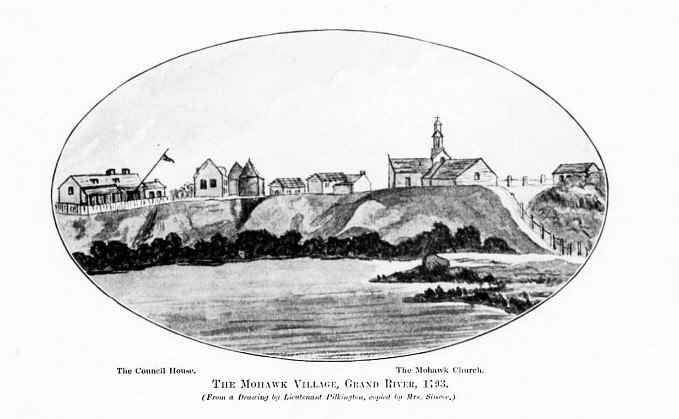
He was responsible for repairs to the Six Nations’ church on the Grand River after it was struck by lightning in 1797, and the same year he built an addition to Upper Canada’s first legislative building at York. In 1799 and 1800 he designed and constructed York’s first government house, a one-story frame structure which stood until 1813, when it was destroyed in the explosion of the adjacent powder magazine.
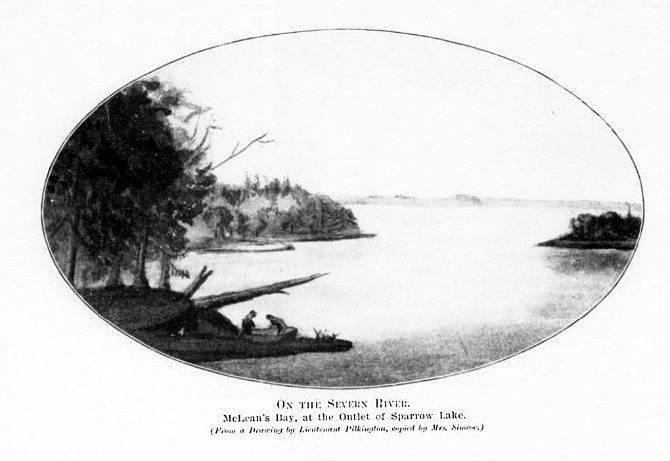
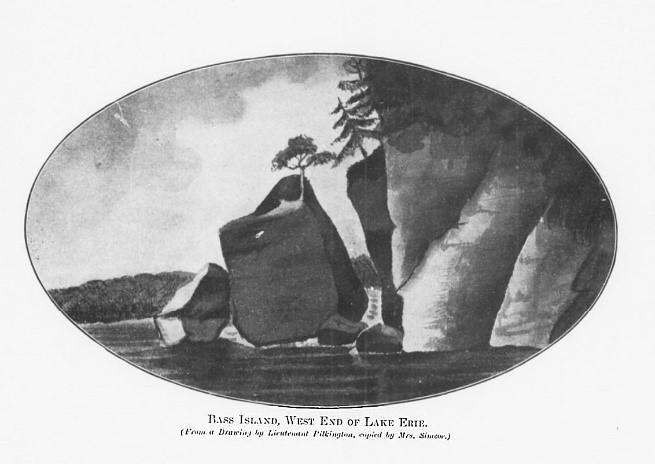
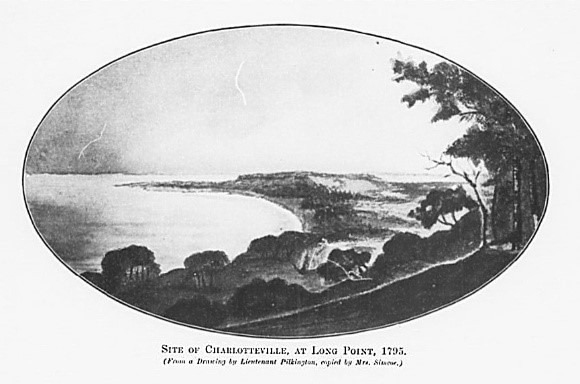
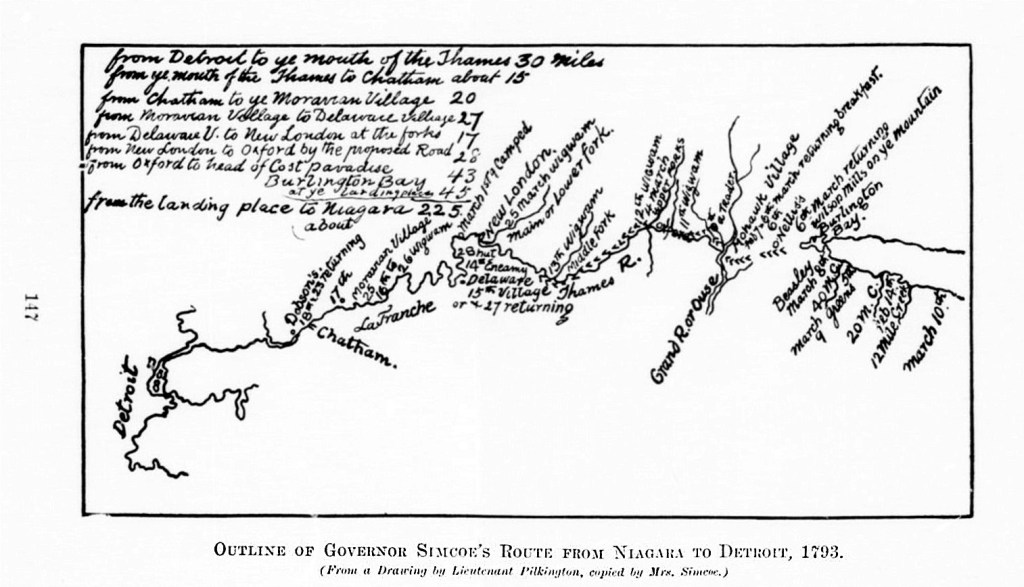
Pilkington also served the function of semi-official cartographer. In 1793, Simcoe forwarded the young engineer’s sketch-map of York harbour to George III, and four days later included him in the group travelling by canoe from Humber Bay on Lake Ontario to Georgian Bay. He drew maps of the waterways along the route and painted several scenes observed during the trip, most notably on the Severn River. In March 1794 Pilkington accompanied Simcoe to Detroit and to the Miamis (Maumee) River. He prepared an improved map of the western Lake Erie region and sketched the Miamis River area, where he also remained behind to rebuild Fort Miamis (Maumee, Ohio).
Social Life in Upper Canada
Not all the engineer’s projects were of obvious public importance. In June 1796, Mrs. Simcoe (Elizabeth Posthuma Gwillim) recorded that “Mr. Pilkington has erected a temporary room adjoining our house for the ballroom tonight. “Indeed, he was referred to many times in Mrs. Simcoe’s Diary. Robert was active in the embryonic social life of the young colony and seems, in particular, to have become a friend of Mrs. Simcoe. In her diary she mentions riding with him and more than once she admits to copying his sketches.
Robert actively took part in the social life that existed in Newark. He was also a friend of John White, Upper Canada’s first attorney general. They often visited one another and attended social events together. After White’s mortal wounding in his duel with John Small on January 3, 1800, Robert broke the news to White’s brother-in-law and patron, Samuel Shepherd, the English jurist. His offer to assume responsibility for White’s two sons was not accepted as they returned to England to be raised by their mother under Shepherd’s general supervision.
According to the Georgian and Regency eras, owning land was a measure of greatness. The landed gentry took top place in ‘who was who’ in Britain and Upper Canada. And Robert was no exception. In addition to about 2,000 acres in York, Newark, and Grantham Township, he obtained 15,000 acres in Woolwich Township. He also owned land in Darlington, Townsend and Newark Townships, in the town of Niagara and in Scarborough. Four of his properties were in Niagara on the Lake (Newark).
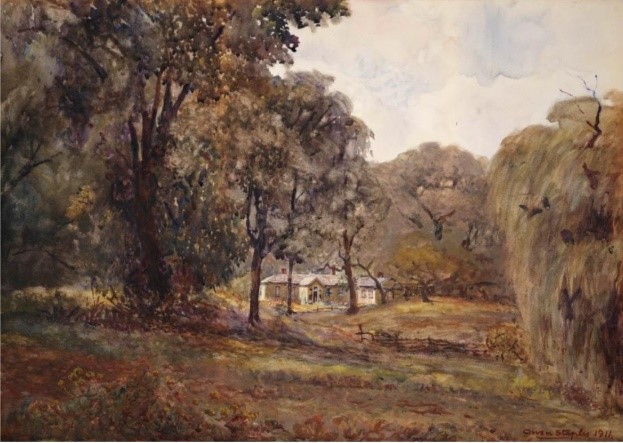
The most interesting was the property at 407 King Street. This remarkable lot of 4 acres, heavily forested in the heart of Niagara-on-the-lake has passed intact through many hands since its origin as a crown grant to a veteran of Butler’s Rangers.
“In 1796 the four original plots that comprise the current property were owned by David Deamud, James Whitten, Joseph Adams and Lieut. Robert Pilkington of the Royal Engineers who was also an aide to Lieutenant Governor Simcoe. Pilkington purchased the entire property and then transferred it to Ann Claus (nee Nancy Johnson) in 1799. At the time, Pilkington reported that he had gifted it to Ann at the request of the Six Nations in exchange for Indian land he received in payment. Why the Six Nations gave the land to her is a bit of a mystery but as the stepdaughter of the legendary Molly Brant, niece of Joseph Brant, the wife of the late Col. Daniel Claus who was the deputy superintendent of Indian Affairs for Canda, she was well known to them, and it was said that she had shown great kindness.”
… the Wonder of the Wilderness by Hermine Steinberg, January 22, 2018
The above article is very interesting and well written demonstrating our history of the Six Nations of the Grand River. (Use control & click to follow this link)
This could possibly solve one of the mysteries that exist with the Pilkington estate property and show how he came to own it.
Back to England
In the fall of 1802, Pilkington returned to England, as Commanding Royal Engineer, to design and oversee the construction of the Royal Ordnance Depot at Weedon, UK. Access to the complex was strictly controlled and the work carried out inside kept highly secret. This historical complex wasn’t decommissioned until 1965.
In 1809 he was sent to the Netherlands where he was in charge of destroying the basin, arsenal and sea defences at Flushing. He returned to England, married in 1810 and by 1832 he was Inspector General of Fortifications.
Despite the fact that he never returned to Upper Canada, Pilkington maintained an interest in Upper Canada. He watched over his Upper Canadian land and sought ways of attracting settlers
Pilkington Township
Block three of the Six Nation Lands on the Grand River had been sold by Joseph Brant to William Wallace, a carpenter from Newark, on February 5, 1798. He called it Woolwich, and it comprised of 86,078 acres. By deed dated May 10, 1799, Wallace transferred a portion of it to Robert Pilkington. This was a rectangular strip of land at the extreme northern end of Black 3 and contained 15,000 acres. It was called Upper Woolwich until 1852 when it was incorporated as the Township of Pilkington and attached to Wellington County.
He arranged to open some roads in his township. The Waterloo, or River Road was opened at his expense and long crossways made. The Guelph and Elora Road was also chopped out from the township line to Elora to the width of half a chain. The site for a future town was chosen on broken front, lot 1, on the 2nd concession, the foundation for a Church was dug, the stone quarried, a limekiln built, a saw mill, and grist mill.
Pilkington persuaded some with whom he had become acquainted at Weedon to emigrate and settle on his land. One of the inducements offered was that each man would receive one hundred acres of land free. They were families of Thomas Lepard, Robert Greenhalgh, Thomas Robinson, George Reeve, Davies, Thomas Smith, Theophilus Smith, George Wilbee, and Christopher Wood.
Thomas Lepard and his wife were among the first who came from England to settle on the Pilkington estate. Lepard was Clerk of the Works at Weedon. They are said to have been in comfortable circumstances in England, and ‘hired’ a ship to convey the party to Canada.
Robert’s Family
Little is known about his family. John Connon, author of the Early History of Elora, states that a son visited at the home of Squire Reynolds after his father’s death and a daughter was the wife of Robert Tylee, of the firm of Maitland, Tylee & Company, at one time merchants in Montreal. I wasn’t able to find any further information of his wife and other children.
Robert and Hannah’s son, Robert John Pilkington, married Jane Shaw and they had a daughter Amy. She was born in April 1855 in Kensington, London, England and married John William Molson of the Canadian Molson family in Montreal. He was the son of John and Anne Molson. He was educated at Bishop’s College, Lennoxville and was engaged in the insurance business. They were married on July 17, 1900 in the Parish of Christ Church, Cheltenham, England. He, a Gentleman, bachelor of 50 and she, a Spinster of 45. They travelled frequently between England and Canada. John William (September 29, 1849) died in Montreal on November 27, 1918. Amy died in Santa Barbara, California USA in March 30, 1939 (83 years old). They had no children.
Pilkington’s Estate
Robert Pilkington died at London, England on the 6th of July, 1834 and was buried at Paddington Old Cemetery, London Borough of Brent, London, England. Robert had made his will on the 15th of May previously, leaving as his executors, his wife, Hannah; John Simcoe Macaulay, a Captain in the Royal Engineers; Edward Tylee, Solicitor, London; and George Tylee, Gentleman of Devizes, Wiltshire. In August they renounced and disclaimed all the real and personal estate leaving Edward Tylee as the only acting executor. He was a nephew of Robert Pilkington.
Robert Pilkington’s death left his estate owing large sums of money. Settlement of the estate and payment of the debts were dependent on the sale of his lands in Upper Canada. The administrators of the estate had difficulty in getting agents to sell the land, in actually selling the land, and in coming to an agreement with people already settled on the Pilkington land.
Christopher Hagerman, friend of the family and Attorney-General of Upper Canada acted as legal advisor to the estate until 1840. James McGill Strachan and partner, John Hillyard Cameron, succeeded as advisors. James Crook, acted as an Agent for land sales. His work was shared for a time by a Captain MacAuley, an executor of the estate who came to Upper Canada to investigate the holdings of the Estate.
The Pilkington Estate wasn’t settled for many more years. The executors for the estate either could not, or would not carry out the agreement to give the settlers their free land. There was only one grant, dated September 9, 1864, given to Mary Ann Lepard, the widow of Benjamin Tribe. She was the granddaughter and heir of Squire Lepard. According to John Connon, there were no descendants in the Township as of 1930.

 people & places
Leave a comment