
The American War for Independence 1775-1783
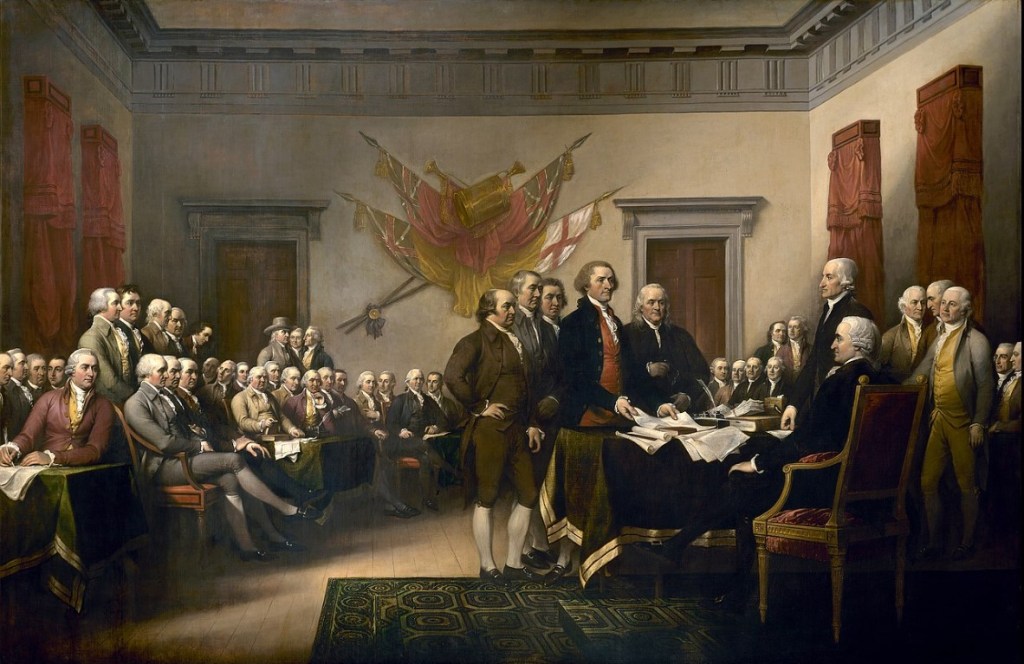
John Trumbull’s 1819 painting depicting the five-man drafting committee presenting the Declaration of Independence to Congress.
The five men who were charged with drafting the Declaration: from left to right: John Adams (chair), Roger Sherman, Robert Livingston, Thomas Jefferson and Benjamin Franklin.
Following the end of the American Revolutionary War and the Treaty of Paris, both Loyalist soldiers and civilians were evacuated, most heading for Canada. Many Loyalists had already migrated to Canada, especially from New York and northern New England, where violence against them had increased during the war.
This Loyalist resettlement was critical to the development of present-day Ontario, and some 10,000 refugees came to Quebec (East and West).
Newark (Niagara-on-the-Lake)
The settlement was founded in 1781 as Butlersburg, in honour of Colonel John Butler, later renamed West Niagara to distinguish it from Fort Niagara. It was a British military base and haven for pro-British loyalists fleeing the United States during the volatile aftermath of the American Revolution. Renamed Newark by Lieutenant-Governor John Graves Simcoe in 1792, it was the first capital of Upper Canda. The legislature first met at Navy Hall on September 17, 1792. In 1797, Simcoe moved the capital to York because Newark was too close to the border with the United States. It was renamed Niagara in 1798.
Birth of a New Province
In 1791 The Constitutional Act followed the Dorchester Proclamation of 1788 and thereby created the first land registry for Quebec Upper Canada and the part of present-day Ontario south of Lake Nipissing, plus the current Ontario shoreline of Georgian Bay, and Lake Superior, and Lower Canada (the southern part of present-day Quebec)
The First Parliament of Upper Canada
The seventeenth of September, 1792, was a joyous and ever memorable day in Niagara. It was glorious weather. The bright little town with its wood and brick houses, each one in a garden of flowers, stood on the verge of the wide common. The broad river ran sweeping by in a majestic curve. The flag of England flaunted on its tall mast in the central area, and its guns looked out from their embrasures ready to make the welkin ring with the royal salute that was to celebrate the inauguration of the new parliament of Upper Canada.
The wide plains were early astir that morning. The Six Nations had come down from the Grand River and encamped on the far side of the common, each nation – Mohawks, Cayugas, Onondagas, Senecas, Oneidas and Tuscaroras – grouped by itself, under their own chiefs, with their women and children, all arrayed in costume and the men armed with rifle, spear and tomahawk. The Mohawks of the Bay of Quinte were there. A large band of Mississaugas was also present, and Chippewas from Sault St. Marie.
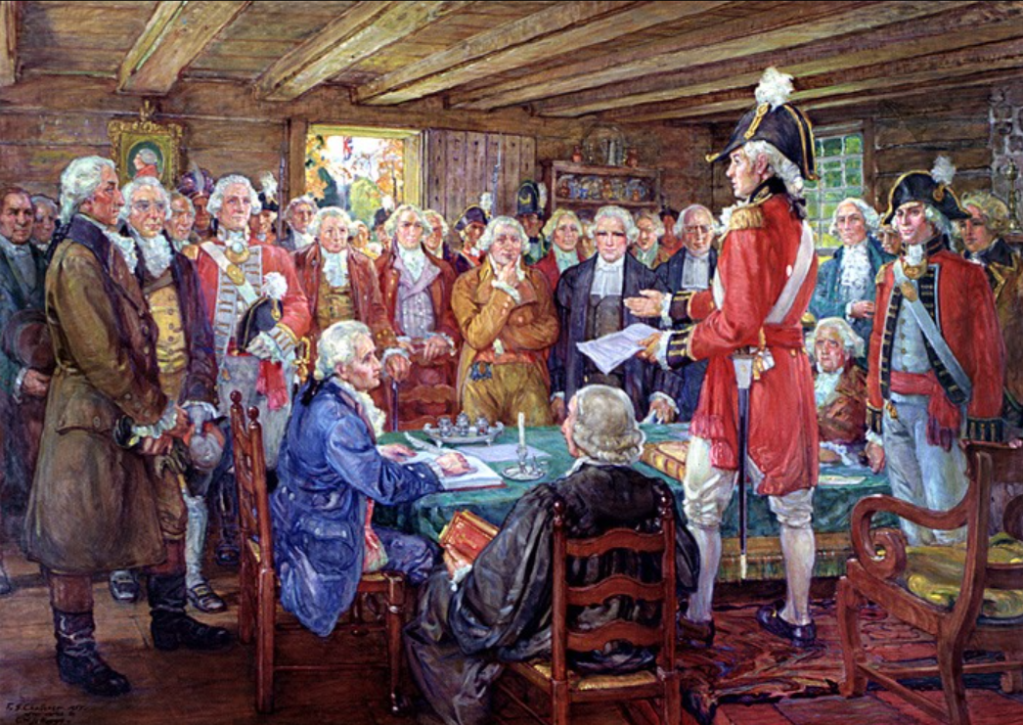
The officers – civil and military – merchants, traders and settlers, had gathered in crowds about the house on the river band, which was to receive the new parliament. Great numbers of the men had donned their old uniforms of the Rangers and other loyal corps in honour of the occasion. All were in their best holiday attire. The men in the fashion of the times – in long coats, vests, and knee breeches with long stockings or gaiters and boots, their hair in queues, surmounted by three-cornered hats, a fashion suited to brave men. The women’s dresses high-waisted, with tight sleeves, and bunched up behind over elaborate petticoats. Handsome women made any dress handsome.
There was Sir John Johnson, the son of Sir William, Colonel Claus, Guy Johnson and Colonel Butler with his Rangers from the barracks.
There was Samuel Street, afterwards the largest land owner and wealthiest man in Upper Canada. He and others filled the place of bankers in those days when no banks had been established. Thomas Clark was a man like Street – rich, honourable and humane.
Guards of honour from the regular regiments, with banks and colours, formed their ranks to receive the Governor and escort him from Navy Hall to the temporary parliament house. He was received with wild, enthusiastic cheers and other demonstrations of joy, and a royal salute from the guns of Fort Niagara. The proceedings were opened by the chaplain (in full canonicals,) the Rev. Dr. Addison.

 people & places
Leave a comment